
Quick Summary:
- Pack for two climates: dry and mild in Tokyo and Kyoto, deep snow and minus 8 celsius in Hokkaido.
- Layers beat one heavy coat, because trains, shops and ryokans are heated to warm temperatures.
- Waterproof and grippy footwear that is easy to take on and off is super important
- Buy thermals, heat packs and ice grips in Japan; they are cheaper there and save suitcase space.
- For onsen and ryokan stays, yukata and towels are provided.
The right Japan winter packing list depends on one question: are you staying in the cities, or heading rural? Tokyo and Kyoto in January sit around 10°C by day and 2°C at night, with dry air and mostly clear skies. Sapporo averages -1°C by day and -8°C at night, with snow on more than half the days of the month. Most of our guests do both on the same trip, which means packing for a cold, dry city walk on Tuesday and a snowshoe trail on Friday without carrying two wardrobes.
This list outlining what to pack for winter in Japan is built from what our guides and guests wear on the White Christmas Tour of Japan and the Snow Spectacular Tour of Japan each year and covers clothing, footwear, the small things that matter, what a ryokan supplies, and what to buy after you land rather than carry from home. For the all-season basics such as adapters, cash and IC cards, see our guide on how to pack for a trip to Japan.
How cold is Japan in winter?
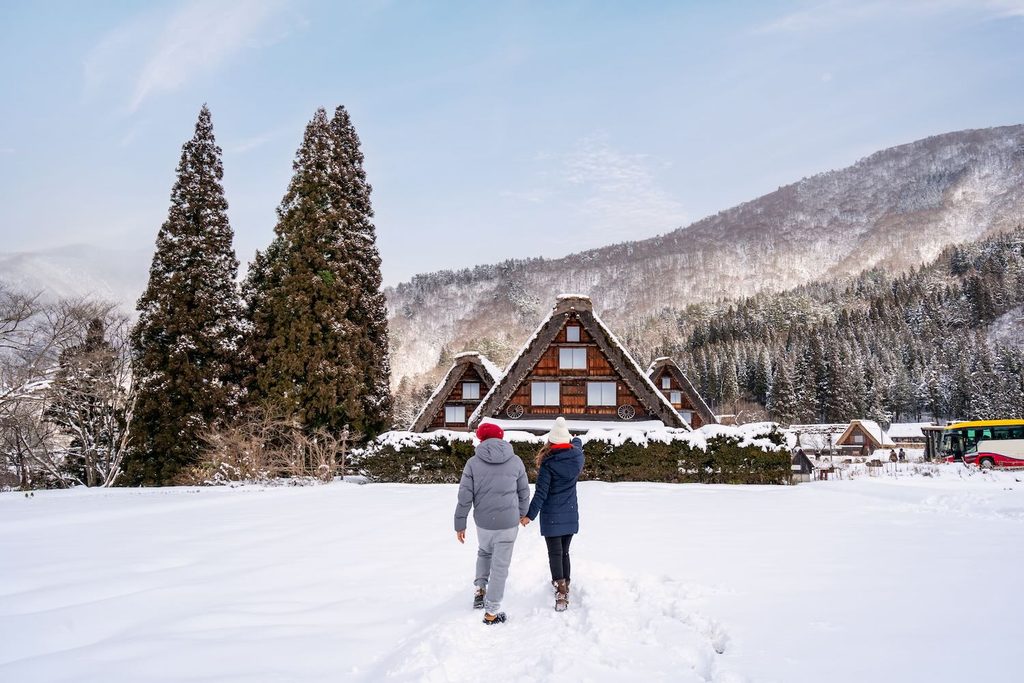
Japan in winter runs from mild to bitter depending on latitude. Tokyo averages 10°C by day and 2°C at night in January, Takayama in the Japan Alps sits at 3°C by day and -5°C at night, and Sapporo averages -1°C by day and -8°C at night, with snow or rain on 50 to 60 percent of days. The Sea of Japan coast and Hokkaido carry the deepest snow; the Pacific side cities usually stay dry. The temperatures that usually catch people out is the indoor one. Trains, shops, restaurants and hotel rooms are heated, often to the mid-20s.
Clothing: a layering system that works from Kyoto to Hokkaido
Three layers cover every day of a winter trip, and only the outer one changes between the cities and the snow country.
Base layer
A thermal top and bottoms against the skin. Merino is warm, light and can often be worn a few times before needing to be washed. Synthetic thermals from the Japanese clothing chains work well too and cost far less than in Australia.
Mid layer
A fleece or fine wool jumper, plus a packable down vest or light down jacket. The down piece is necessary and versatile as it can be used as your outer layer in warmer temperatures and can go under your coat in the snow.
Outer layer
For a city-only trip, a wool or insulated coat is enough. For Hokkaido, the Japan Alps or the Sea of Japan coast, you want a hooded, waterproof, insulated jacket rated to -15°C or below. Sapporo snow is dry and powdery, but you will be standing still outdoors at the Snow Festival at night, which is where a city coat may not provide the warmth you need. Waterproof over-trousers earn their place if snowshoeing or the drift ice walk is on your itinerary. (Rental outerwear for snowshoe walks and drift ice walk are included in the tour).
For the rest: four or five long-sleeved tops, two pairs of trousers (not jeans for snow days, they soak through and stay wet), sleepwear warm enough for a ryokan where the heating goes off at night, and underwear for five days, because coin laundries and hotel laundry services are everywhere.
Footwear: the item that makes or breaks the trip
If you take one piece of advice from this packing list for winter in Japan, make it this one. You will walk 8 to 12 kilometres on many days, take your shoes off at every ryokan, temple hall and at some restaurants, and in the north you will walk on packed snow and ice that the city does not clear from footpaths.
- Cities only: waterproof leather or Gore-Tex walking shoes or low boots with a proper tread.
- Hokkaido and the Alps: insulated, waterproof boots with a deep lugged sole, worn in before you fly. Smooth-soled fashion boots pose a reasonable slip hazard and should be avoided where possible.
- Slip-on or side-zip styles, or laces you can undo in seconds. Across two weeks you will remove your shoes many times.
- Ice grips that stretch over the sole. Buy them in Japan for 500 to 1,000 yen at any convenience store or station kiosk in Hokkaido, and put them on before you leave the hotel.
- Wool socks, five or six pairs, with no holes.
Leave the second pair of boots at home. One good winter pair plus light shoes for evenings and the cities is all you need, and the boots go on your feet for the flight.
Accessories and the small things our guides never travel without
- Gloves with touchscreen fingertips plus a thin liner pair for the coldest mornings.
- A beanie that covers your ears, and a scarf or neck gaiter you can pull over your face in the wind.
- Kairo, the disposable stick-on heat packs sold at every convenience store and drug store, to put in your pocket or in your boots.
- Lip balm and a good moisturiser. Winter air in Japan is dry, indoor heating is drier, and cracked lips can arrive within a couple of days.
- Sunglasses. Snow glare on a clear day can be as bright as a beach in January.
- A small foldable daypack for the layers you shed indoors, and a reusable shopping bag, since plastic bags cost extra in Japan.
- A compact umbrella if you are on the Sea of Japan side; in Tokyo and Kyoto a 500 yen one from a convenience store will have you covered.
What to pack for onsen and ryokan stays
This is where first-time winter visitors overpack. A ryokan supplies a yukata (the cotton robe worn to dinner, the bath and bed), a padded tanzen coat for the walk to an outdoor bath, slippers, bath towels, a small modesty towel, hair dryer and basic toiletries. Most onsen bathing is done without swimwear, so leave the swimmers at home unless you are visiting a clothed onsen or a hotel pool.
What you do want is a hair tie if your hair is long, since it must stay out of the water, a small waterproof pouch for your room key and phone, and warm socks for the walk back from the outdoor bath. If you have a tattoo, pack a few waterproof covering patches. Many onsen still ask that tattoos be covered, and our guides will tell you which baths on your tour are relaxed about it.
What to buy in Japan instead of packing
Some of the best winter kit in the world is sold in Japan for less than you would pay at home, and buying it there helps keep your bag under the weight limit.
- Thermal base layers from the big Japanese clothing chains, around 1,000 to 2,000 yen a piece, with heavier grades for Hokkaido. Sizes run small, so if you wear an Australian XL or above, bring your thermals from home
- Kairo heat packs, in boxes of ten or thirty, at any convenience store or pharmacy
- Ice grips for your boots, sold at stations and convenience stores across Hokkaido from December
- Umbrellas, face masks and hand sanitiser, all cheap and everywhere
- Ski and snowboard gear, if you are adding days on the slopes. Resorts rent everything, including outerwear, so there is no reason to fly with it
The complete Japan winter packing list
Here is the whole thing in one place, for a two-week trip that mixes the cities with snow country.
Clothing
- 3 to 4 thermal tops and 2 thermal bottoms (merino or synthetic)
- 4 to 5 long-sleeved tops
- 1 fleece or wool jumper and 1 packable down jacket or vest
- 1 hooded, waterproof, insulated winter jacket
- 2 pairs of warm, water-resistant trousers, plus over-trousers if snowshoeing
- 5 to 6 pairs of wool socks, underwear for 5 days, warm sleepwear
Footwear
- 1 pair of insulated, waterproof, lugged winter boots (worn in)
- 1 pair of light slip-on shoes for evenings and city days
- Ice grips (buy in Japan)
Accessories
- Touchscreen gloves and liner gloves, beanie, scarf or neck gaiter
- Sunglasses, lip balm, moisturiser, compact umbrella
- Foldable daypack, reusable shopping bag, hair tie, waterproof pouch, tattoo covers if needed
- Kairo heat packs (buy in Japan)
Documents and tech
- Passport, travel insurance details, flight confirmations, a copy of your tour itinerary
- Type A plug adapter, power bank (cold drains phone batteries fast), spare camera battery
- Medication in original packaging with a doctor’s letter, and some yen in cash for the smaller towns
Japan Winter Packing List: Frequently Asked Questions
Do I need snow boots for Tokyo and Kyoto in winter?
No. Both cities rarely see snow settle, and footpaths are dry most winter days. Waterproof walking shoes or low boots with a good tread are enough, and they double as your evening shoes. Save the insulated, lugged boots for Hokkaido, the Japan Alps and the Sea of Japan coast, where packed snow and ice stay on the ground from December to March.
Can I buy winter clothes in Japan if I am a larger size?
Up to about an Australian large, yes, and the Japanese chains sell excellent thermals and down jackets at lower prices. Above that, sizing becomes hit and miss outside the biggest Tokyo stores, so bring your base layers, boots and outer jacket from home and treat Japanese shops as a place to top up on socks, gloves and heat packs.
What should I wear to the Sapporo Snow Festival at night?
Evening temperatures at Odori Park sit around minus 5 to minus 8, and you will be standing still looking at sculptures rather than walking to stay warm. We recommend wearing a thermal top and bottoms, a mid layer, your insulated jacket, trousers, beanie, scarf, gloves, and heat packs in your pockets and boots.
Is it hard to walk on snow and ice in Hokkaido?
Not with the right soles. Footpaths in Sapporo and Hakodate are compacted snow for most of winter, and locals get around in lugged boots with rubber ice grips stretched over them. Worn-in winter boots, grips bought on arrival for a few hundred yen, and shorter steps are all it takes. Our guides set a pace that suits the ground, and the snowshoe walks on our winter tours are on flat or gently sloping trails.
Our team packs for Hokkaido every winter. See our winter tours of Japan, or call +61 7 3368 1966 and we will tell you what to bring for the departure you have in mind.
About the author
The Journey to the East Team, Japan small group tour operators, ATAS and CATO accredited
Journey to the East has run small group and private tours of Japan for 13+ years, with teams in Queensland, Australia and in Japan. Every itinerary is handmade by our own staff and never subcontracted, and our guides spend each winter on the ground from the Japan Alps to the drift ice at Shiretoko. Call +61 7 3368 1966 to talk through a winter tour.