
Christmas in Japan starts at about 4.30 pm on Christmas Eve, when the sun drops behind the office towers, and a million small lights come on along Marunouchi Naka-dori. The trees turn champagne gold from trunk to tip, and somewhere down the avenue a woman in a red coat is holding a white cake box very carefully in both hands.
Nobody here has the day off, less than 1 per cent of the population is Christian, and there is no turkey anywhere. Yet the season is everywhere: on the department store facades, in the convenience store fridge full of reserved chicken, in the couples booking a table for two on the 24th. Then, on the morning of the 26th, the country packs the whole thing away and turns to something older. This is what that fortnight feels like.
Does Japan celebrate Christmas?
Japan celebrates Christmas, or Xmas as the ads shorten it, just not the one you grew up with. It is not a public holiday, and schools, banks and offices run as normal. What Japan celebrates is the season: the lights, the cake, a night out, a small gift for someone you love. It arrived through Meiji-era department store windows and post-war advertising, and it stayed because it is fun and asks nothing of anyone. The mood is closer to Valentine’s Day, and Christmas Eve belongs to couples. Travelling with family or friends, you will feel like a guest at someone else’s party. It is a very good party.
Christmas Eve in the city: the night of the lights
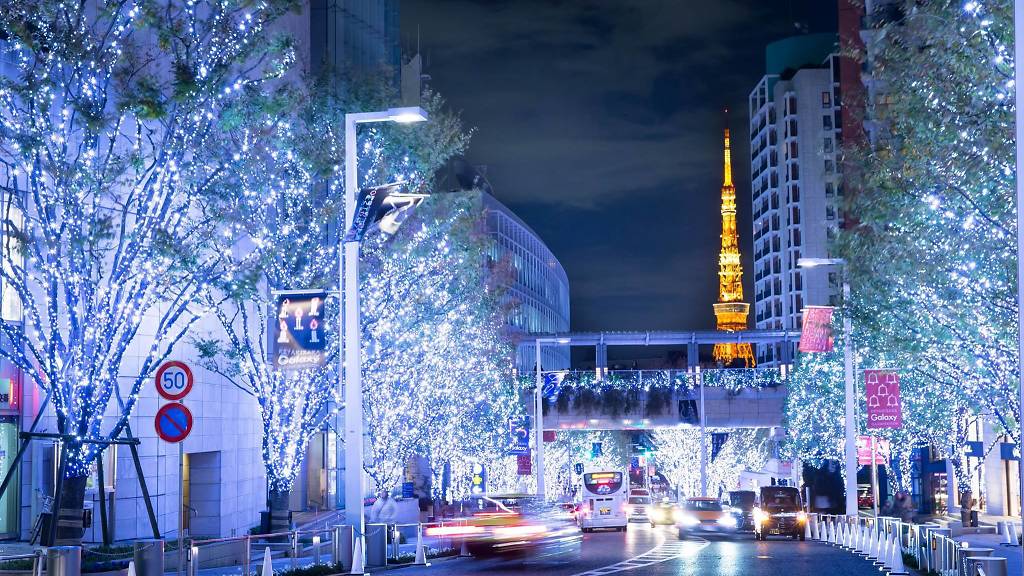
Every Japanese city lights up for December, and the word for it, illumination, is said in English. In Tokyo, the Marunouchi trees run for more than a kilometre between the station and the Imperial Palace moat. In Roppongi, the Keyakizaka slope is strung in blue and white with Tokyo Tower glowing orange at the bottom of it, and people stand in the crossing to take the photograph, then scatter when the lights change. Osaka does the same along four kilometres of ginkgo trees on Midosuji.
Underneath the lights, the department store food halls are doing their best trade of the year, and they smell of butter and roasting chestnuts. There are queues at the cake counters, staff in Santa hats calling reservation numbers, and gift boxes of strawberries the size of golf balls, each cradled in its own paper cup. By 10 pm, the trains are full of people carrying cake boxes and small paper bags with ribbon.
What does Japan eat at Christmas?
Fried chicken and strawberry shortcake. Ask anyone from Hokkaido to Kyushu, and those two answers come back every time. On the evening of the 24th, there is a queue outside every KFC in the country, most of it collecting a Party Barrel reserved in November. KFC Japan pitched Kentucky for Christmas in 1974 to families with no turkey tradition, and half a century on, Christmas Eve is still its busiest day of the year.
The cake is a Christmas cake in name only: a light sponge layered with whipped cream and fresh strawberries, red and white like the flag, sold in Yokohama as early as 1910. You reserve one, collect it on the 24th and eat it that night with the lights off and candles lit. Whatever is left on the 26th goes for half price, which tells you how sharply the season ends.
For the traveller, the pleasure is in the small things around those two. Hot amazake, sweet and cloudy, from a shrine stall. Oden simmering by the convenience store till. Mandarins peeled under a kotatsu, the low heated table every living room gathers around in winter. And, in the far north, mulled wine in a commemorative mug at a Christmas market under real snow.
Christmas in the snow country
Head north or into the mountains and Christmas in Japan turns white. In Sapporo, the German Christmas Market has run in Odori Park since 2002, a nod to the city’s sister-city ties with Munich: bratwurst, hot wine, and a different mug each year that locals collect. It sits inside the White Illumination, so you drink your wine looking down an avenue of lit trees with snow settling on your shoulders.
Hakodate does something stranger and lovelier. A fir shipped from Halifax in Canada is floated in the harbour in front of the red brick warehouses and lit from top to bottom. At 6 pm every evening through December, there are fireworks over the water, and the whole town comes down to stand in the cold and watch. Ride the ropeway up Mt Hakodate afterwards, and the city lies below you in a narrow neck of light between two dark bays, with a Christmas tree glowing in the middle of it.
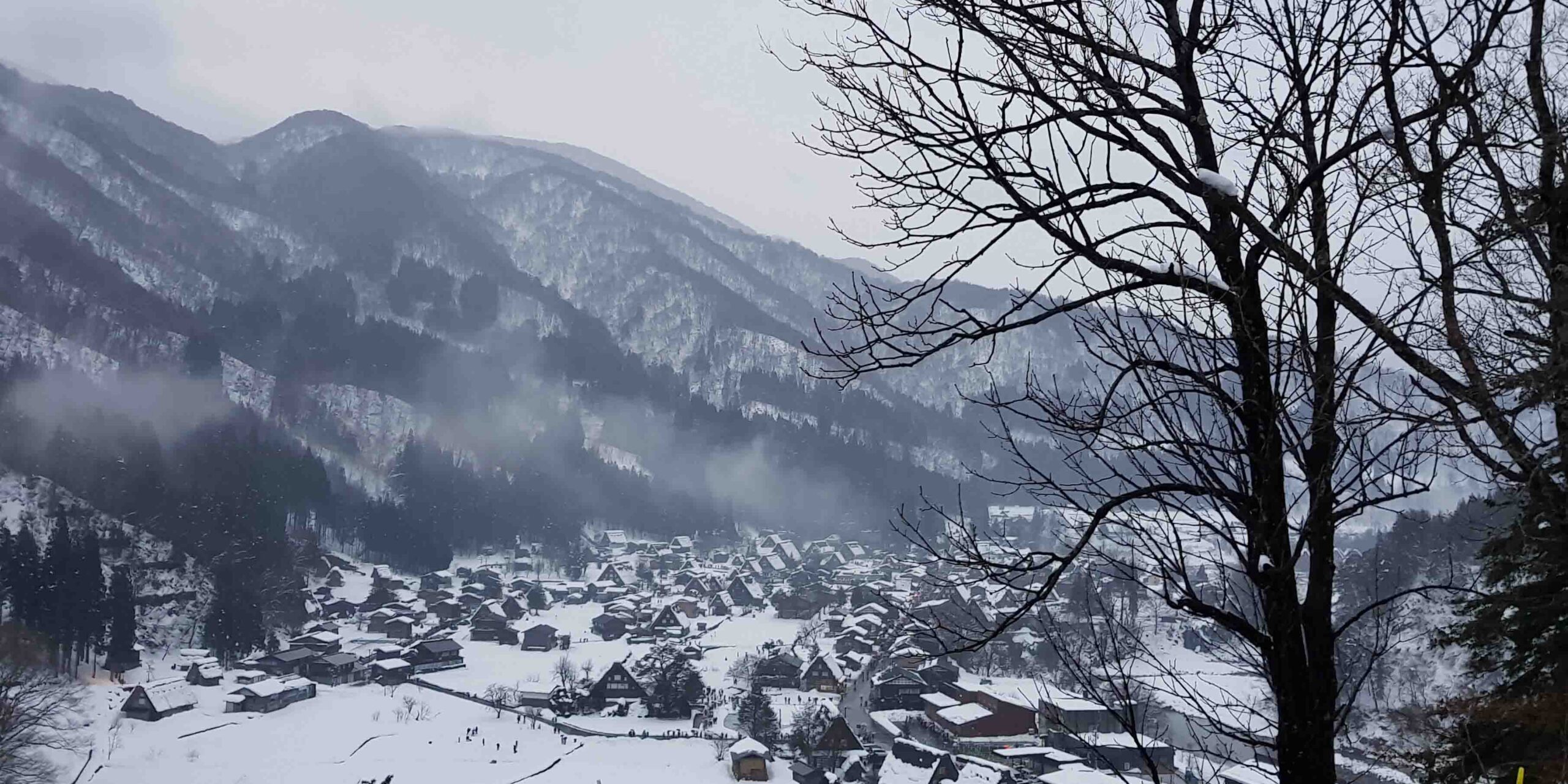
In the Japan Alps the season is quieter still. Takayama’s old merchant streets hang cedar balls outside the sake breweries rather than tinsel, and the morning market runs in the cold with pickles and hot sweet buns. An hour away, the thatched farmhouses of Shirakawa-go sit under a metre of snow, roofs steep as praying hands. There is no Christmas here at all, which is why a December afternoon there feels like a gift. Our White Christmas Tour of Japan is built around that contrast: Tokyo’s lights, then the Alps, then Christmas Eve on Mt Hakodate and dinner in the town below, eight guests around one table. It is the kind of table a coach party of twenty-odd cannot book.
The morning after: how Japan turns to New Year
Wake up on 26 December and the country has changed clothes overnight. Kadomatsu, paired arrangements of cut bamboo and pine, stand on either side of shop doorways, and rice-straw ropes with a mandarin and a fern hang above front doors. Families start osoji, the great year-end clean, and in country towns you hear the thud of mochi being pounded in a wooden mortar. Christmas took a fortnight to build. Shogatsu, the New Year, takes over in a morning, because it is the holiday that matters here.
If you can, stay. On the night of 31 December, temple bells ring 108 times to see out the year’s failings, and around midnight families walk to the local shrine for hatsumode, the first prayer of the year. In a mountain village, that means a lantern-lit path through snow, a bonfire, amazake in paper cups and forty or so neighbours who want to know where you are from.
The version we love most is New Year in a ryokan. Arrive on the 30th or 31st, eat toshikoshi soba at the inn, long buckwheat noodles for a long life, walk to the shrine with the owner’s family, and wake in the dark for hatsuhinode, the first sunrise, watched from an outdoor bath with steam rising off the water. Breakfast is osechi ryori, lacquered boxes of black beans, herring roe and candied chestnuts, each carrying a wish for the year. Nothing else is expected of you for three days. Good inns fill up far ahead, so plan early, and our team in Japan books the rooms directly.
Planning Christmas in Japan: the practical part
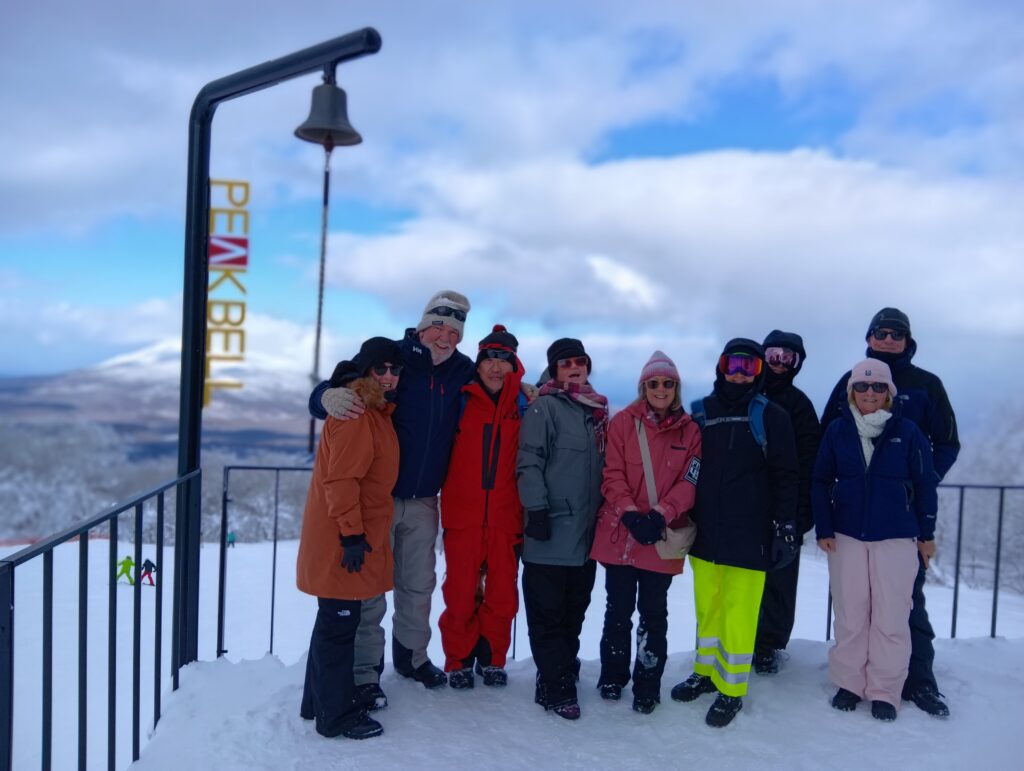
December is one of the best months to be in Japan. Tokyo and Kyoto sit around 5 to 10 degrees by day under clear skies, the Alps drop below zero at night with snow from mid-month, and Sapporo and Hakodate hover around freezing with snow on the ground. The sun sets about 4.30 pm, so the lights start early and so does dinner. Pack a proper coat and good shoes. Christmas Day itself is easy, as everything is open. The week after is not, and the bullet trains out of Tokyo on 28 to 30 December and back in on 2 to 4 January sell out early, because the whole country is travelling home at once. That is a reason to book early and travel with someone who knows which doors will be open, not a reason to stay away.
Frequently Asked Questions
Is anything closed on Christmas Day in Japan?
No, December 25 is an ordinary working day, so shops, museums, restaurants, temples and trains keep normal hours, and the illuminations run their final night. Book dinner ahead on Christmas Eve, when couples fill restaurants with a view. The closures come a week later, from about 29 December to 3 January, when most museums, restaurants and small shops shut. Temples, shrines, hotels, ryokan and convenience stores stay open throughout.
Can I see the Shirakawa-go winter light-up at Christmas?
The 2027 light-up runs on four January evenings (11, 17, 24 and 31 January, 5.30 pm to 7.30 pm) and every visitor needs a reservation, by bus tour, pre-booked parking or the farmhouse-stay lottery drawn in November. In mid-December, the village sits under snow in daylight with a fraction of the visitors, which many of our guests prefer.
How far ahead should I book Christmas or New Year in Japan?
Christmas week hotels in Tokyo and Kyoto are best booked three to six months out. New Year ryokan stays need longer, because many inns hold rooms for families who return every year. Other popular places such as ski resorts book out a year in advance. The New Year period is a special time to travel, but it is also the most difficult time to find a working guide, as most private guides take their own holidays then. Trips during this period are likely to be self-guided, so it is worth considering before you commit to those dates. Our White Christmas Tour departs 12 December 2026 with a maximum of eight guests, and a New Year ryokan stay can be added as a private tour.
If a Christmas of lit avenues, a harbour tree in the snow and a New Year sunrise from an onsen sounds like your kind of December, Contact Us Today on +61 7 3368 1966, and we will talk through the White Christmas Tour and private New Year options.
About the Author
The Journey to the East Team, ATAS and CATO accredited
Journey to the East has run small group and private tours in Japan for more than a decade, with over 472 tours and more than 1,656 travellers hosted, rated 4.9 out of 5. Every tour is designed and organised in-house by our teams in Japan and Australia and led by licensed local guides who know the trails, towns and inns in this article first-hand. We are a member of ATIA and hold ATAS and CATO accreditation.